Design for Context / MyUSPTO
Make account management clearer.
Co-leading research and design at Design for Context for MyUSPTO contact, payment, and account-management workflows.
- My role
- Senior Design Consultant / project co-lead
- Context
- Design for Context, supporting USPTO
- Scope
- Account-management research and design
- Status
- Earlier consultancy work
The operating problem
Routine tasks crossed service boundaries.
People doing business with the United States Patent and Trademark Office needed ways to manage contact and payment information. The earlier service relied on separate channels and staff support for routine updates.
Account management also carries questions of responsibility, financial meaning, validation, and recovery when something goes wrong. Those concerns needed to be examined together.
My contribution
Connect research with account workflows.
As a project co-lead at Design for Context, I conducted interviews, contextual inquiry, and workflow analysis with agency and delivery partners. We examined how inventors, legal representatives, and businesses managed information and where routine tasks depended on separate channels or staff support.
I designed and tested account and payment workflows and co-created a dashboard concept for contact information, payment profiles, and correspondence. Iterative prototypes and design reviews addressed financial labels, validation, and error recovery.
Historical interface / MyUSPTO
Make the account and the next action understandable.
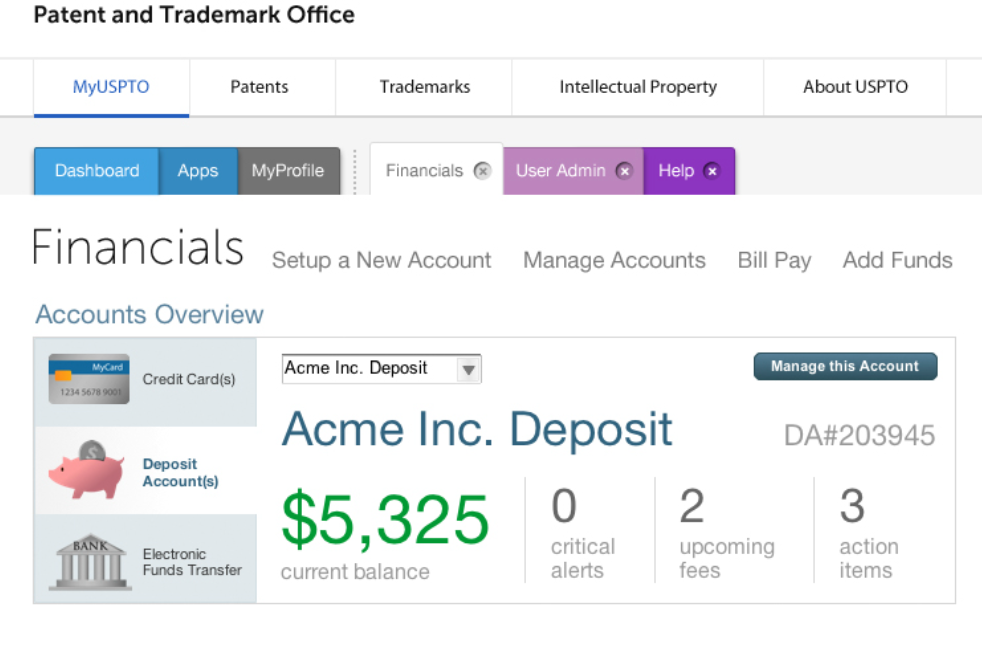
The screen groups payment methods separately from the selected account’s balance, alerts, upcoming items, and action items. It provides a concrete example of the financial information and choices the work needed to organize.
The design question was broader than placing fields on a page: people needed to understand which account they were managing, what required attention, and where to act. The screen illustrates that information hierarchy; it does not establish usability-test results or production processing times.
View full artifact image →Choices in the work
Three connected decisions.
Prioritize routine account tasks
Bring contact and payment management into the design focus so the team could examine where people depended on staff or separate channels.
Make financial meaning explicit
Examine labels, validation, and error handling in prototypes rather than treating payment management as a generic form.
Iterate with delivery partners
Use research, prototype testing, and design review to discuss usability and implementation constraints together.
Evidence and limits
Research, account workflows, and iterative design.
The documented contribution includes research, workflow analysis, account and payment prototypes, and iterative review. It was a co-led consultancy effort with agency, design, and engineering partners.
Accessibility was a design consideration. This account does not assert formal conformance, a specific reduction in processing time, or independently measured improvements in trust.
Reflection
Self-service needs clarity and recovery.
Moving a task online is only part of the service. People also need to understand the information they are changing, recognize problems, and know how to recover.
Discuss this work: rob@robfay.com