ResearchOps, DesignOps, and measurement: the practical foundations teams needed to use evidence and shared guidance.
Role
Senior Manager, HCD Center of Excellence
Context
Contractor practice supporting CMS
Focus
Enterprise capability and continuous improvement
Featured artifact
HCD maturity whitepaper · 2020
Original publication / HCD Center of Excellence
HCD Maturity Model: Assessing Human-Centered Design Adoption in the Enterprise. HCD CoE, July 2020. The publication introduces the assessment framework.
My contribution
Build the practice around the tools.
I led the HCD Center of Excellence team as a contractor supporting CMS. Our work combined research operations, design-system advocacy, training, and experience measurement. It depended on collaboration with product teams, researchers, designers, and agency partners.
I procured and managed an enterprise Dovetail repository and its taxonomy, and developed participant recruitment and research-support pathways. The team created onboarding and training, playbooks, and a shared library of personas and journeys. I championed the enterprise design system and connected HCD practice with product-team planning and review.
The operating problem
Teams needed more than another tool.
Delivery teams worked across programs and contracts, while many of the same people encountered multiple CMS services. Research could remain inside individual projects; shared guidance was not always connected to day-to-day delivery; teams needed a way to assess where their HCD practice required support.
The work connected three practical needs: finding and using existing evidence, applying shared design guidance, and deciding where to improve next.
01 / ResearchOps
Make research discoverable and reusable.
I procured and managed the enterprise Dovetail research repository and its taxonomy. The aim was to let teams find relevant work beyond their own project rather than start every research question from scratch.
The repository was only one part of the practice. I also developed a centralized participant-recruitment email list and a research-support request pathway so teams had somewhere to begin when they needed participants or help planning research.
Concrete work
A shared repository for qualitative and quantitative evidence.
Structured metadata and tagging to organize findings across projects.
Recruitment and support channels for teams conducting research.
These are capabilities created and managed. Their existence alone does not measure research reuse or faster decisions.
02 / DesignOps
Help teams apply the shared guidance.
I championed the CMS enterprise design system and connected HCD practice with product-team planning and review. The contribution was advocacy and enablement, not authorship of the entire design system.
Our team developed onboarding, training, playbooks, and a library of personas and journeys. HCD liaisons and recurring practitioner roundtables helped connect the shared guidance with the questions teams encountered in delivery.
Guidance people could use
Onboarding and training explained HCD and accessibility expectations. Playbooks, reusable patterns, and persona and journey references gave teams material they could bring into their work.
Support around the guidance
Planning and review conversations, HCD liaisons, and practitioner roundtables provided places to discuss how the guidance applied to a particular product or service.
03 / Measurement
Assess the practice and listen to the customer.
The team used HCD maturity assessment to examine how research, design, staffing, strategy, scope, and measurement were supported. The assessment created a baseline for discussing where teams and leadership could focus their next effort.
Customer feedback and product measures complemented that organizational view. The work included Voice of the Customer feedback, Customer Effort Score surveys, and the use of tools such as Qualtrics and Matomo alongside goals and help-desk information.
Maturity assessment asks how the organization supports the practice. Customer feedback and behavioral data ask what people experience. Bringing those perspectives together helps frame an improvement question; it does not, by itself, prove that an intervention worked.
Artifact / Organizational responsibility
Look beyond the design team.
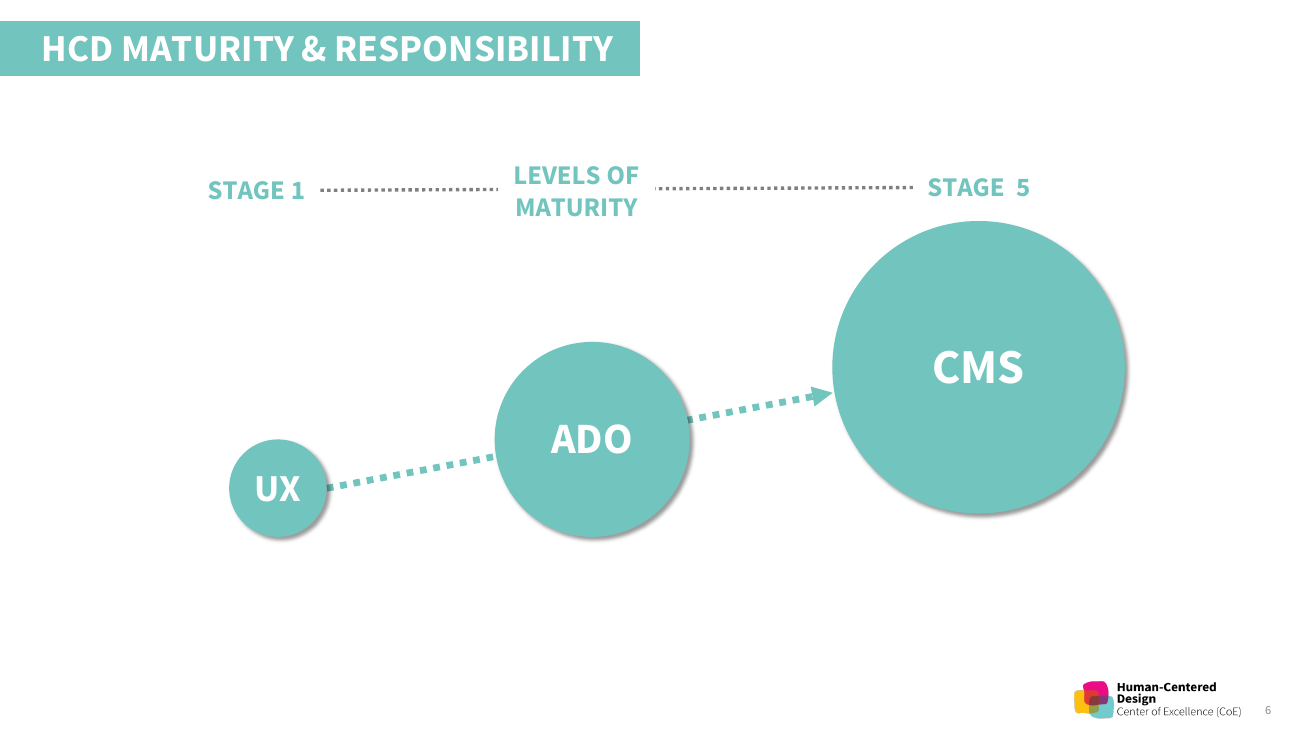
Conceptual model of maturity and responsibility. This is a framework for the conversation, not a measured improvement result.
HCD CoE · Enterprise report · page 6 · 2020
Responsibility is shared.
The diagram makes the organizational scope visible: design practice depends on the delivery organization and agency context as well as the UX team.
UX: research and design practice. ADO: the application development organization. CMS: the wider agency and its operating conditions.
Evidence to action
A finding should inform a next decision.
Finding / Research practice
The enterprise report describes regular research alongside constraints on end-user access and the diversity of methods used.
Proposed next step
Broaden access to end users and enable a wider range of research approaches. Use subsequent assessment to learn whether the changes help.
Paraphrased from the report’s research findings and opportunity questions. This describes a proposed action, not a verified outcome.
Independent practice / Gumshoe
Assess where to focus next.
The CMS work demonstrates the approach. Independent maturity-assessment services belong at Gumshoe; that offering is being developed.
The work produced a shared research repository and taxonomy, recruitment and support channels, training and playbooks, and mechanisms for maturity assessment and customer feedback. These are concrete capabilities; their existence alone does not establish adoption or customer impact.
This account describes contractor practice leadership and cross-team enablement. It distinguishes the capabilities created from their adoption and measured effect on customer experience.
A shared capability needs an operating model.
Tools, guidance, and training reinforce one another when people know how to use them and where to get help. The leadership task is connecting those pieces to the decisions teams actually need to make.