Service design / An illustrative example of my approach
Beyond the frame.
Design the whole service around the person.
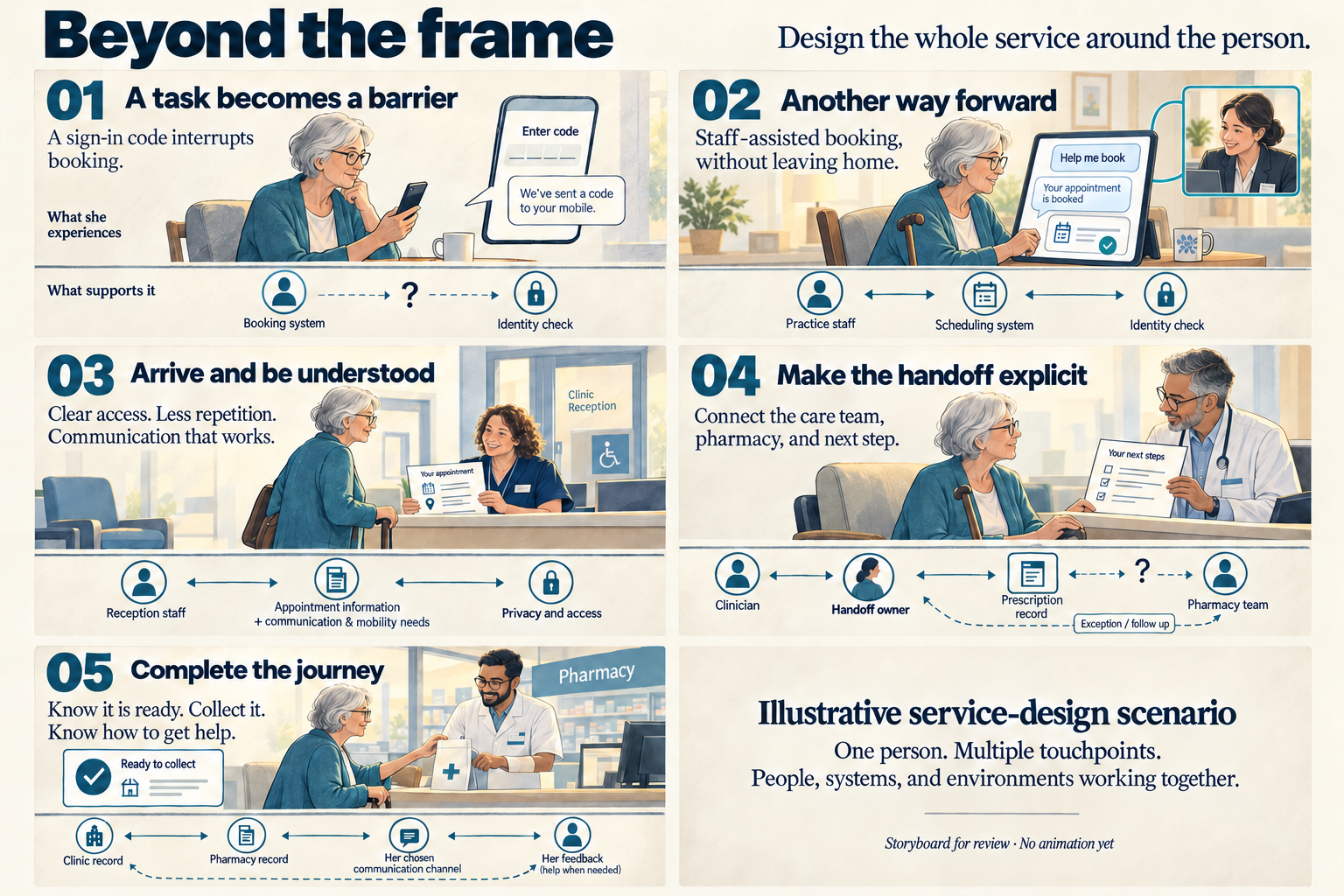
This fictional journey follows one independent older woman whose hearing, mobility, and digital-access needs shape the service. These are her circumstances, not assumptions about every older adult.
One person. A connected service.
From booking at home to collecting medicine, every interaction depends on people, information, environments, and clear responsibilities.
01 / 05
A task becomes a barrier
A sign-in code interrupts booking.
A user-started, five-scene story with brief movements within each step. Each scene holds for eight seconds. There is no audio. The full written and illustrated sequence follows.
The complete service, step by step.
Above the boundary is what she experiences. Below it are the people, systems, and responsibilities that support it. The artwork stays on a paper surface in both themes.
01 / 05
A task becomes a barrier
What she experiences
She wants an appointment, but switching between a sign-in screen and a verification message interrupts the task.
What supports it
Authentication, scheduling, and support need an accessible recovery route that preserves identity checks.
02 / 05
Another way forward
What she experiences
She chooses readable written assistance from a practice staff member and receives an appointment confirmation at home. The staff portrait represents a remote human; video or hearing is not required.
What supports it
Staff assistance connects to scheduling and appropriate identity checks. Her communication and mobility preferences are recorded with her consent.
03 / 05
Arrive and be understood
What she experiences
Readable directions, accessible entry, seating, and face-to-face written communication support her arrival.
What supports it
Reception, facilities, and the care team coordinate requested accommodations and share only the information needed.
04 / 05
Make the handoff explicit
What she experiences
The clinician provides written next steps and agrees how she will learn when her prescription is ready.
What supports it
A named handoff owner coordinates clinic and pharmacy responsibilities, including missing information and follow-up. Separate organizations retain their own records.
05 / 05
Complete the journey
What she experiences
She receives a readiness update before travelling, collects her medicine through an accessible route, and knows whom to contact with questions.
What supports it
The chosen communication channel, pharmacy handoff, and recovery and feedback routes complete the service. This illustrates coordination, not a guaranteed health outcome.